
Livi Egg Layer Cage for 25,000 Layers in Nigeria: Engineering Requirements and Site Readiness Verification
Quick Answer: What a 25,000-Layer Livi Egg Layer Cage Project in Nigeria Requires
Planning a 25,000-layer farm in Nigeria is not a cage purchase alone. It requires coordinated verification of site, housing, power, water, climate, and equipment configuration. Livi Machinery supplies the H1200 layer cage system with hot-dip galvanized cage mesh, automatic feeding cart, auger feed delivery, manure belt, and optional egg collection, ventilation, and environmental control. Before any final layout or quotation, project planners need confirmed house dimensions, electrical phase and frequency, water availability, and climate data. Nigeria's hot climate makes heat management a central engineering requirement, so ventilation and cooling cannot be copied from a template. The final cage count, row spacing, and tier configuration must be calculated after site conditions are verified.
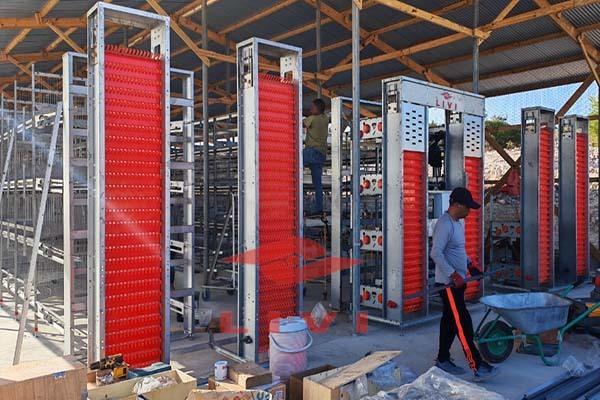
Project Background and Why H1200 Layer Cage Fits a 25,000-Layer Nigeria Farm
A 25,000-layer farm is a commercial-scale egg production project, large enough to justify automated feeding, drinking, manure removal, and environmental control. It requires a system that reduces manual labor and maintains consistent daily production.
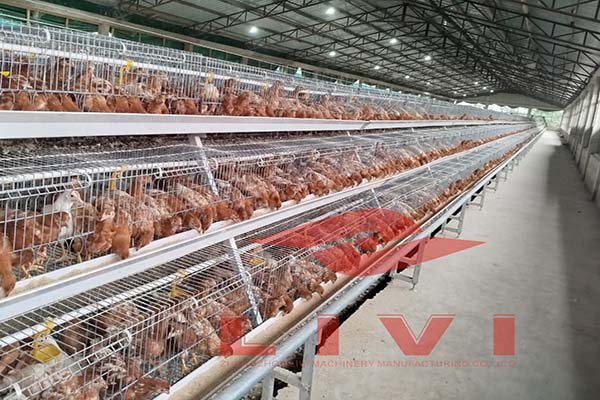
Livi Machinery has 13 years of poultry equipment experience and serves markets including Africa. The Livi H1200 layer cage system uses Q235 hot-dip galvanized cage mesh with a 7° bottom slope for smooth egg rolling, 25 mm bottom wire spacing for stable claw support, and modular design for faster installation and future expansion. Structural parts use zinc-aluminum-magnesium material: cage support post 2.0 mm, feed trough 1.0 mm, trough bracket 2.0 mm, K board 1.0 mm. The system is designed for high humidity and ammonia environments common in poultry houses.
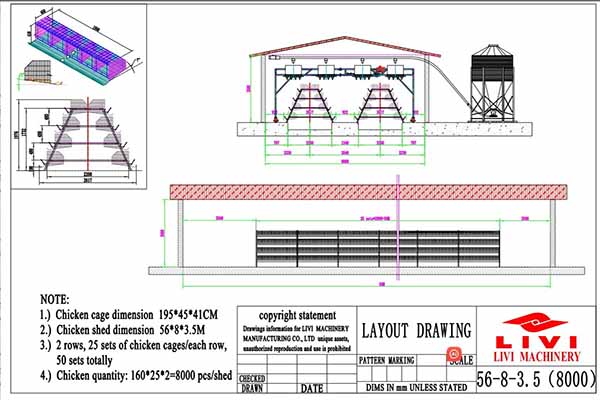
However, the H1200 series does not have a fixed number of tiers or cages for 25,000 layers. A-type and H-type configurations, tier count, and row layout depend on available land, house width, clear height, budget, and labor. Nigeria's climate demands that ventilation, insulation, and cooling strategy be selected from site-specific temperature and humidity data, not from a universal fan count.
Verified Livi H1200 Layer Cage Components
The following table lists verified Livi product specifications for the H1200 layer cage series and the site checks needed before final design in Nigeria.
| Component | Verified Livi Specification | Site Readiness Check for Nigeria |
|---|---|---|
| Cage mesh | Q235 steel wire, hot-dip galvanized, bottom wire 2.3 mm, side/partition 2.3 mm, door wire 4.0 mm, support wire 2.5 mm, bottom spacing 25 mm, 7° slope | Confirm house width and row spacing for installation tolerance; check floor levelness |
| Feeding cart | Zinc-aluminum-magnesium frame 3.0 mm, hopper 1.0 mm, 0.75 kW motor with gear reducer | Confirm stable power supply and aisle clearance for cart travel |
| Auger | PVC outer pipe 110 mm diameter, 3 mm wall, 1.1 kW motor, carbon steel spiral core | Plan feed bin location and auger route from bin to cage rows |
| Manure belt | Zinc-aluminum-magnesium frame 3.0 mm, PP belt 1.2 mm, dual 0.75 kW motors, triple cleaning device, anti-deviation rollers | Ensure manure discharge path and cleaning access at house end |
| Structural parts | Cage support post 2.0 mm zinc-aluminum-magnesium, trough 1.0 mm, trough bracket 2.0 mm, K board 1.0 mm | Verify foundation strength and anchoring before installation |
Note: No site-specific cage count, row numbers, or fan counts are available in the project outline. These values must be determined after the buyer provides verified house dimensions, electrical details, and climate data.
Site Information Required Before a 25,000-Layer Proposal
Livi can prepare a project-specific proposal after receiving:
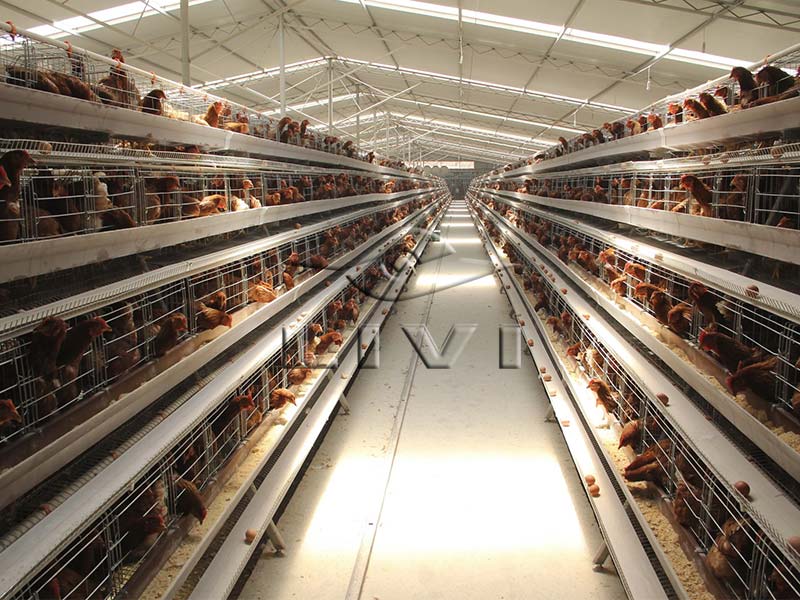
- House dimensions: length, width, clear height; number of houses; whether buildings are new or existing.
- Electrical supply: voltage, phase, frequency, backup power availability. For motor-driven feeding, manure, and ventilation systems, phase and frequency must match the equipment.
- Water source and storage: daily water capacity, pressure, and quality.
- Climate data: local temperature, humidity, seasonal variation, and preferred ventilation approach.
- Site layout: land boundaries, access roads, future expansion direction.
- Manure management plan: discharge point, removal frequency, and storage or composting area.
Without these inputs, fixed cage quantities and fan counts cannot be honestly calculated.
Nigeria Site Readiness Walkthrough for a 25,000-Layer Project
A typical 25,000-layer planning sequence would include:
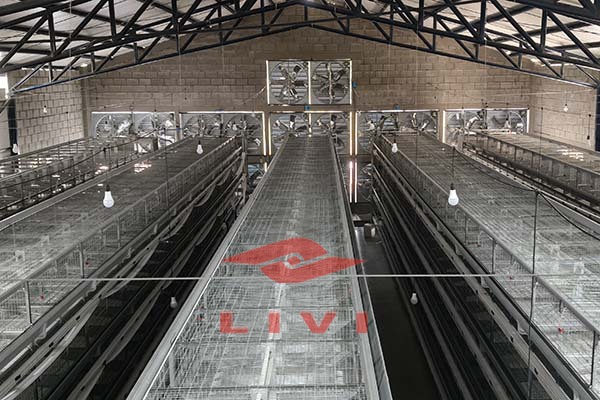
- House verification – Confirm building dimensions and clear height meet the proposed multi-tier H1200 layout; check that sidewall openings and roof insulation suit the ventilation design.
- Power configuration – Verify available voltage, phase, and frequency; plan backup power for feeding, manure, and ventilation critical loads.
- Water supply – Confirm storage volume and pressure for drinking lines and any cooling pad system.
- Feed handling – Determine bin location and auger route; ensure access for feed delivery.
- Manure removal – Lay out the PP manure belt discharge path and daily removal schedule.
- Cage layout – After house and utility verification, Livi calculates row spacing, tier count, and cage quantity.
- Future expansion – Reserve land, power, and water capacity for additional houses or higher bird numbers.
This walkthrough does not rely on any single named customer or claimed project result; it uses the H1200 system capabilities and established engineering checks to help a Nigeria-based investor prepare for a valid quotation.
Installation and Training Scope
Livi supports installation and operator training as part of project delivery. The exact scope—on-site supervision, remote guidance, or documentation—must be confirmed in writing. Local labor coordination, site readiness, and final electrical/water connections are generally the buyer's responsibility unless otherwise agreed. Suggested installation sequence:
- Confirm final house dimensions, foundation strength, and floor levelness.
- Complete site preparation: power supply, water connection, backup power readiness.
- Unload and inspect all cage mesh, structural parts, feeding and manure components against the packing list.
- Assemble cage rows and structural frames according to the approved layout drawing.
- Install feeding cart, auger system, water lines, and manure belt per Livi guidance.
- Connect electrical motors and control systems, verifying phase and voltage match.
- Conduct trial operation of feeding, manure removal, and any automated egg collection or ventilation systems.
- Provide operator training on daily checks, cleaning, and basic troubleshooting.
Transportation and On-Site Delivery Considerations
Livi equipment is packaged in modular, factory-tested units to reduce shipping volume and protect components during long-distance transport. Buyers should confirm container access, offloading equipment, and road conditions from port to farm before shipment. Site storage must be dry and secure to protect galvanized cage mesh, electrical motors, and PVC/manure belt components before installation. Freight cost, route, and transit time are not fixed and must be confirmed after the final equipment list and project location are defined.
FAQ
What Livi egg layer cage model is suitable for 25,000 layers in Nigeria?
Livi's H1200 layer cage system is a commercially available layer cage series. The exact model configuration—number of tiers, rows, and cages—depends on verified house dimensions and layout. A 25,000-layer project typically uses a multi-tier configuration selected after evaluating land width, building height, and automation goals.
What site information is required before Livi can provide a 25,000-layer farm proposal?
Required site information includes house dimensions (length, width, clear height), number of houses, new or existing status; electrical supply details including voltage, phase, frequency, and backup power; water source, storage capacity, pressure, and quality; local temperature, humidity, and ventilation approach; and future expansion plan.
Does Livi provide installation and training support for Nigeria projects?
Yes. Livi represents installation and training support as part of project delivery, but buyers should confirm the exact scope—on-site, remote guidance, or documentation—in writing. Local labor coordination and site readiness are typically the buyer's responsibility unless otherwise agreed.
How does the Livi H1200 layer cage system handle manure removal?
The H1200 system can integrate an automatic manure belt. Livi specifies a PP belt of 1.2 mm thickness, zinc-aluminum-magnesium frame of 3.0 mm, and dual 0.75 kW motors with gear reducers. The system includes triple cleaning devices, tension adjustment, and anti-deviation rollers. Exact belt length and motor count depend on house layout.
Can this 25,000-layer farm be expanded later?
Yes, Livi supports future expansion planning. The site layout and utility capacity should reserve room for additional houses or cages. If land constraints or power capacity change significantly, a different cage type or house design may be needed.
What are the key engineering risks for a hot climate like Nigeria?
Heat stress management is critical. Ventilation and cooling must be designed from site-specific temperature and humidity data, not generic fan counts. Power stability for ventilation motors and water supply for cooling pads are essential, and backup power should be planned for critical loads.
Plan Your 25,000-Layer Nigeria Project with Livi
Plan your 25,000-layer Nigeria project with Livi Machinery. Share your house dimensions, power supply, water availability, and climate data to receive a customized Livi egg layer cage system proposal with engineering layout and equipment configuration. Contact Livi for a project-specific review before construction or expansion.







